

Cricket is a bat-and-ball game played between two teams of 11 players on an oval-shaped field, at the centre of which is a rectangular 22-yard long pitch. One team bats, trying to score as many runs as possible while the other team bowls and fields, trying to dismiss the batsmen and thus limit the runs scored by the batting team. A run is scored by the striking batsman hitting the ball with his bat, running to the opposite end of the pitch and touching the crease there without being dismissed.
Showing posts with label Books of Cricket.. Show all posts
Showing posts with label Books of Cricket.. Show all posts
Saturday, 19 November 2011

Cricket, Literature and Culture

In his important contribution to the growing field of sports literature, Anthony Bateman traces the relationship between literary representations of cricket and Anglo-British national identity from 1850 to the mid 1980s. Examining newspaper accounts, instructional books, fiction, poetry, and the work of editors, anthologists, and historians, Bateman elaborates the ways in which a long tradition of literary discourse produced cricket's cultural status and meaning. His critique of writing about cricket leads to the rediscovery of little-known texts and the reinterpretation of well-known works by authors as diverse as Neville Cardus, James Joyce, the Great War poets, and C.L.R. James. Beginning with mid-eighteenth century accounts of cricket that provide essential background, Bateman examines the literary evolution of cricket writing against the backdrop of key historical moments such as the Great War, the 1926 General Strike, and the rise of Communism. Several case studies show that cricket simultaneously asserted English ideals and created anxiety about imperialism, while cricket's distinctively colonial aesthetic is highlighted through Bateman's examination of the discourse surrounding colonial cricket tours and cricketers like Prince Kumar Shri Ranjitsinhji of India and Sir Learie Constantine of Trinidad. Featuring an extensive bibliography, Bateman's book shows that, while the discourse surrounding cricket was key to its status as a symbol of nation and empire, the embodied practice of the sport served to destabilise its established cultural meaning in the colonial and postcolonial contexts.


Cricket County Acadmey

SYNOPSIS Shiver me timbers! The Ollingsford sisters are in dire straits after notorious French pirate

Golden Boy: Kim Hughes and the bad old days of Australian cricket

ORION | 2009-08-06 | ISBN: 1741750679 | 324 pages | File type: PDF | 11 mb
The Magic Indian Cricket, Revised Edition: Cricket and Society in India

Routledge | 2006-04-19 | ISBN: 0415356911 | 284 pages | File type: PDF | 1,1 mb
John Ayto "Wisden Dictionary of Cricket "

AC Black (2007-09-01) | ISBN 0713679158 | 576 Pages | File type: PDF | 4.7 mb
Saturday, 12 November 2011
Heroes Of Pakistan Cricket

Book name "Heroes of Pakistan Cricket Team. Complete bio-data of 36 stars Pakistanis cricketers . A gift for those, whose love cricket on the occasion of ICC World Cup 2011.
Download link:- http://www.mediafire.com/?8nxf58wu2qaq07a.
Thursday, 18 August 2011
Be in Not Out


ICC World Cup 2011
There is nothing like being at the place of action. Where the excitement is palpable, the crowds real and watching your favorite team win, unforgettable. And come February 2011, the center of cricketing action will shift to the thirteen venues in the subcontinent that are hosting the various matches. So, what do you have to do to ensure that you are in and not out? Well, it is rather simple really: Download and read this handbook and then go online and buy Tickets will be sold in two major phases.
Download Link:- http://www.mediafire.com/?3fv5k8rbbs92tyf
Monday, 15 August 2011
Cricket and the Law

Book title is "Cricket And The Law, The man in white is always right".
Written By David Fraser.
Download Link:- http://www.mediafire.com/?5jpolbhlcbnpdqk

The dictionary of Cricket

Title of the book is "DICTIONARY OF CRICKET" written by Michael Rundell.
Download Link:- http://www.mediafire.com/?ma7xi2u71mvk7jl
The Law of Cricket
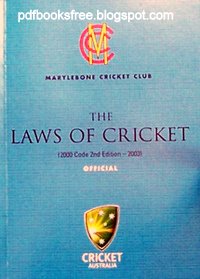
The game of Cricket has been governed by a series of Codes of Law for over 250 years. These Codes have been subject to additions and alternations recommended by the governing authorities of the time. Since its formation in 1787, the Marylebone Cricket Club (MCC) has been recognized as the sole authority for drawing up the Code and for all subsequent amendments. The Club also holds the World copyright.
The basic laws of cricket have stood remarkably well the test of well over 250 years of playing the game. It is thought the real reason for this is that cricketers have traditionally been prepared to play in the Spirit of the game as well as in accordance with the Laws.
In 2000, MCC revised and re-wrote the laws for the new Millennium.In this code, the major innovation was the introduction of the Spirit of Cricket as a preamble to the laws. Whereas in the past it was assumed that the implicit spirit of the game was understood and accepted by all those involved, MCC felt it right to put into words some clear guidelines, which help to maintain the unique character and enjoyment of the game. The other aims were to dispense with the Notes, to incorporate all the points into the laws and to remove, where possible, any ambiguities, So that captains, players and umpires could continue to enjoy the game at whatever level they might be playing. MCC consulted widely with all the full member countries of the International Cricket Council, the Governing Body of the game. There was close consultation with the Association of Cricket Umpires and Scorers. The Club also brought in umpires and players from all round the world.
This latest version, The Laws of Cricket (2000 Code 2nd Edition 2003) includes several necessary amendments arising from experience and practical application of the Code around the world since October 2000.
To learn the complete Laws of Cricket, you can download
this in pdf format from this link. http://www.mediafire.com/?ijg077i9y2iu7i2
One Who Will The Search For Steve Waugh

Title of this book is "ONE WHO WILL" The Search for Steve Waugh by Jack Egan. A gift for the Cricket fans.
Download Link:- http://www.mediafire.com/?7twifmeetxv9zv0
Cricketing Cultures In Conflict World Cup 2003 by Boria Majumdar and J.A Mangan in pdf

Download link pdf format:- http://www.mediafire.com/?z6ha0xozkcmi5y5
All the books posted here are just for educational purposes only. If you like the books please support the writers/poets and buy the Original hard copies.
Heroes of Pakistan Cricket Team
Book name "Heroes of Pakistan Cricket Team. Complete bio-data of 36 stars Pakistanis cricketers . A gift for those, whose love cricket on the occasion of ICC World Cup 2011.
Download link:- http://www.mediafire.com/?8nxf58wu2qaq07a
Don't forget comments
Wednesday, 10 August 2011
The Cricketer's Progress - Meadowland To Mumbai

The Cricketer's Progress - Meadowland To Mumbai
In this delightful synoptic history of the game, Gideon Haigh finds Midwinter to be ‘fond without sentimentality, thorough without pedantry, and wears his learning lightly’.
J. Neville Turner writing in the Australian cricket magazine The Yorker claims that By virtue of its wit, scholarship, mastery of language, vision, modesty and wisdom, Eric Midwinter’s The Cricketer’s Progress has persuaded me that it is the finest book on cricket of all time.
J. Neville Turner writing in the Australian cricket magazine The Yorker claims that By virtue of its wit, scholarship, mastery of language, vision, modesty and wisdom, Eric Midwinter’s The Cricketer’s Progress has persuaded me that it is the finest ook on cricket of all time.
SHORTLISTED FOR THE MCC/CRICKET SOCIETY BOOK OF THE YEAR - the citation reads: The distinguished writer Eric Midwinter has produced a book that could be classified as social history, were that not an inadequate term for what is contained within. Conscious of the salient point that to study history one must needs study the historian as well, the author takes us on a journey from cricket’s uncertain origins to its equally uncertain present state.
The journey, however, is the point and a skilled and witty mind traces the fortunes and misfortunes of cricketers, not just cricket itself, and places the players and the game squarely in the context of contemporary history.
AUTHOR DETAILS
The social historian, Eric Midwinter, is the author of many books, among them several on cricket. These include: W.G.Grace; His Life and Times (1981). The Lost Seasons; Cricket in Wartime 1939-45 (1987). The Bass Illustrated History of County Cricket (1992). Red Shirts and Roses; the Story of the Two Old Traffords (2005, winner of the Cricket Society/Times Cricket Book of the Year Award).
Not In My Day, Sir - Edited By Martin Smith

Not In My Day, Sir - Edited By Martin Smith
For more than eighty years the Telegraph’s Letters page has offered an august forum for the discussion of all manners of subjects, but none has been as durable as cricket. Be it the Bodyline controversy, the d’Oliviera and Packer affairs, or the sticky question of players chewing gum out in the middle, Telegraph readers have never been short of an opinion or several, wryly or even cholerically expressed. Before stumps are drawn, they will have dropped into their mailbox for possible publication their trenchant thoughts on such matters of national importance.
Over the years The Daily Telegraph’s Letters page has attracted many contributions from the great and the good, including legendary Test cricketers like Percy G.H Fender and C. B Fry, the finest cricket correspondents like E.W Swanton and Neville Cardus, presidents past and present of MCC, and aggrieved county captains seeking a right of reply, as well as the likes of Lords Longford and Tebbit, Field Marshal Lord Bramall and Tim Rice and Graeme Hick. But most of all it is the home of the cricket-watching public, letting off steam with great wit and good humour at the way their favourite sport is being run.
Now Martin Smith has put together a collection of the very best cricket letters to The Daily Telegraph. By turns acerbic, witty, opinionated and hilarious, they are always to the point, silly or otherwise.
EXCERPTS
SIR- Following the triumphant open-topped bus tour through London in 2005, should the England cricket team be made to fly home from Australia in an open-topped plane?
Dr S. McMenemin, Coylton
SIR – When I got married in 1955 my husband told me he was going to give me the greatest thrill a girl could have on her honeymoon: he took me to Lord’s.
Joyce Mantell, Tamworth
SIR – If the Pope’s presence at Westminster Abbey was seen as sufficient reason to interrupt BBC Radio 4’s cricket commentary, could we invite him to stay here indefinitely?
David Gray, Richmond, North Yorkshire
Open an account with bet365 today and qualify for up to £200 in free bets with our fantastic 100% Deposit Bonus.
The Physics Of Cricket - Mark Kidger

The Physics Of Cricket - Mark Kidger
Cricket – it’s not rocket science, right? Well, yes – from
today, it is, thanks to a new book “The physics of cricket” from Mark Kidger.
The author, a real-life rocket scientist working with the European Space Agency, has joined forces with Nottingham University Press to produce a “must have” book for everyone who takes their game seriously, from armchair pundits to coaches seeking that vital edge.
Its 200 pages will improve games, ignite debates, explode myths, settle arguments and clinch pub quizzes from West Sussex to the West Indies; from the Oval, London, to its namesakes in Adelaide and Bridgetown.
“The Physics of Cricket” reveals how players already employ anatomy in ways they didn’t realise, and can harness optics, mechanics, fluid dynamics, materials science, statistics, infrared technology, and acoustics to their advantage – if only they knew how. It pinpoints a range of factors including…
· The chances of winning the toss seven times in a row – it’s once in every one hundred and twenty eight series. But winning the eighth toss too – higher odds, or 50-50?
· How a flying cricket ball can be as formidable as a low velocity bullet – so what stops it killing the batsman?
· The optimum angle for hitting a six – it’s 45 degrees in theory; what about in practice?
· Precisely what happens when the ball leaves the bowler – and why is the angle of nine degrees – or 12-15 degrees if facing a spinner – critical to the batsman?
· Why a bowled ball can apparently hit the same point three times, yet bounce differently each time – how can the bowler use this to unnerve his opponent?
· Understanding bats – for example, heavier can hit farther, but can carry a serious problem
· … And, vitally - Controversy has been the cause of at least one High Court case over ball tampering. If you understand the way that the ball behaves, the use of the information given by the author will give you that extra edge using perfectly fair means to master a vital skill.
Just for fun – and because cricket is now indeed rocket science – author Mark Kidger even answers the question: "if cricket were played on the moon, how far back would the spectators sit for safety?"
The book is illustrated by a wealth of diagrams, and explains the facts behind renowned events in cricketing history.
Mark said: "For years, everyone from schoolboys to world class cricketers have perfected their skills, often based on intuition – but, actually, physics.
"Now, for the first time, they can not only explore what’s going on as they enjoy playing and watch others, but improve their game through understanding the many factors they can influence.
Subscribe to:
Posts (Atom)